


Throwing a baseball at high velocity is one of the most physically demanding actions in sports, making proactive shoulder care for pitchers absolutely critical. Whether you are a high school athlete in Centennial or a weekend warrior in South Denver, prioritizing shoulder care for pitchers is the only way to ensure longevity on the mound and prevent season-ending injuries.
The repetitive motion of pitching places immense stress on the rotator cuff and labrum. Without a dedicated maintenance routine, that stress eventually leads to breakdown. At TruStrength Performance and Rehab, we believe that pain shouldn’t force you to hang up your glove. Our goal is to bridge the gap between rehabilitation and performance, helping you build resilience so you can throw harder, longer, and without pain.
In this guide, we will explore why the pitcher’s shoulder is so vulnerable, how to structure a routine that prevents injury, and the specific therapies available right here in Colorado to keep you in the game.
The Anatomy of the Pitching Shoulder
To understand how to protect the shoulder, you first have to understand how it works. The shoulder joint is often described as a golf ball sitting on a tee. It has an incredible range of motion, which is necessary for the mechanics of throwing, but that mobility comes at the cost of stability.
The rotator cuff is a group of four small muscles responsible for keeping that “golf ball” centered on the “tee” while your arm whips forward at high speeds. When these muscles become fatigued or imbalanced, the larger muscles take over, leading to poor mechanics. This is often where trouble begins. Common issues we see in our Denver clinics include:
- Rotator Cuff Tendonitis: Inflammation caused by overuse.
- GIRD (Glenohumeral Internal Rotation Deficit): A loss of internal rotation range of motion.
- Scapular Dyskinesis: Improper movement of the shoulder blade, which destabilizes the entire arm.
Addressing these issues requires more than just ice and rest. It requires a comprehensive approach to movement and capacity.
The TruStrength Approach to Recovery
Recovery isn’t just about sitting on the sidelines; it is an active process. We utilize a four-pillar system—Structure, Mindset, Movement, and Capacity—to ensure a holistic recovery.
1. Structure
We begin by identifying structural issues. Is there soft tissue damage? Are there muscle imbalances? By catching these early through a comprehensive assessment, we can correct the root cause of the pain rather than just treating the symptoms.
2. Mindset
An injury can be mentally devastating for a pitcher. Our team helps you foster mental resilience, setting achievable goals that keep you motivated throughout the rehabilitation process.
3. Movement
This is where the magic happens. We use specific exercises to restore pain-free mobility. Whether you are recovering from a rotator cuff tear or managing elbow pain, our sports rehab program focuses on movement variability to restore function.
4. Capacity
Once you are moving well, we build strength. We want to increase your physical capacity so that the demands of pitching don’t exceed your body’s ability to handle them.
Essential Therapies for Pitchers
While a good warm-up and cool-down are vital, sometimes the body needs extra help to recover from the trauma of pitching. We offer several specialized treatments at our Centennial and Denver locations designed to accelerate healing.
Dry Needling for Release
Pitchers often develop tight “knots” or trigger points in the lats, rotator cuff, and traps. Dry needling is a highly effective technique where thin needles are inserted into these trigger points to stimulate a release. This can improve range of motion and reduce pain significantly faster than stretching alone.
Manual Therapy
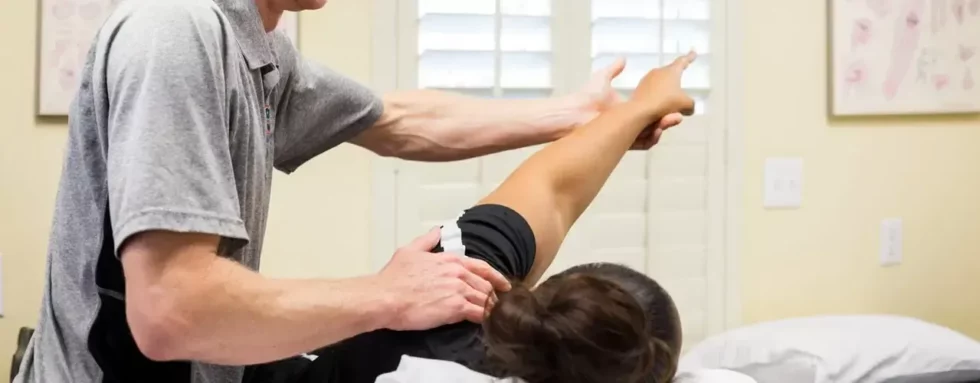
Hands-on treatment is often necessary to mobilize stiff joints and improve tissue quality. Our massage therapy and manual therapy services help flush out metabolic waste from muscles and improve circulation, preparing your arm for its next bullpen session.
Physical Therapy and Strengthening
Passive treatments feel good, but active strengthening creates long-term changes. Our physical therapy programs focus on strengthening the scapular stabilizers and the rotator cuff. We teach you how to train in the presence of an injury, modifying movements so you can maintain fitness while your shoulder heals.
When to See a Professional
Many pitchers try to “push through” the pain, thinking it’s just part of the game. However, ignoring the warning signs can lead to surgery. You should seek professional help if you experience:
- Pain that lasts more than 48 hours after throwing.
- A “dead arm” sensation or sudden loss of velocity.
- Pain that radiates down the arm or up into the neck.
- Difficulty lifting your arm above your head or reaching behind your back.
Direct Access in Colorado
A major benefit for athletes in our state is Colorado’s “Direct Access” law. This means you can visit a physical therapist without a prescription or referral from your primary care physician. You don’t have to wait weeks to see a specialist; you can start your recovery journey immediately.
Staying Healthy on the Mound
Shoulder care for pitchers is an ongoing commitment. It involves a combination of proper mechanics, workload management, and regular maintenance therapy.
At TruStrength Performance and Rehab, we are proud to have over 200 five-star reviews from patients who have trusted us with their recovery. We don’t just want to get you back to baseline; we want to help you build a body that is resilient enough to handle anything the game throws at you.
If you are dealing with shoulder pain or want to build a prevention program, come see us at our Steele St, Centennial, South Denver, or South Broadway locations. Let’s build your true strength.