


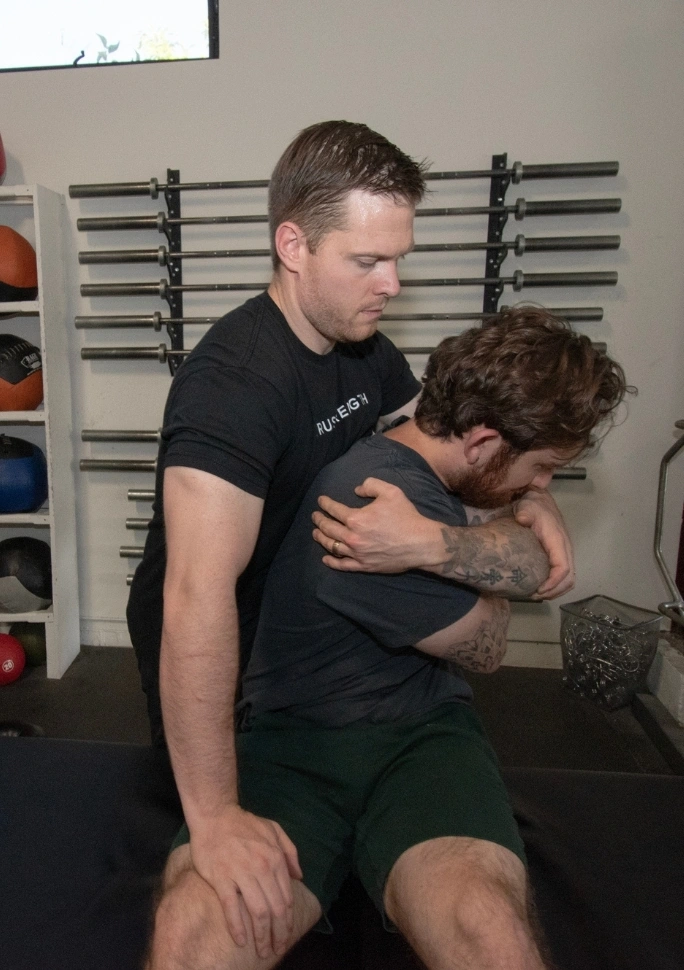
Manual therapy for shoulder pain can feel like the missing link when you want to keep lifting, running, or playing and your shoulder keeps nagging you.
You are not looking for a quick rubdown; you want to understand why your shoulder hurts and how hands on work can actually help you get back to training with confidence.
Maybe your shoulder lights up every time you press overhead, serve a few games of pickleball, or hit a long ride out of the saddle.
You ice it, scroll mobility videos, swap a few exercises, and it still comes back every time you push the pace.
You probably have not slowed down because that is not how you are wired.
At the same time, you are tired of guessing whether that next workout will set you up for a personal record or another flare up.
In this article, we will break down what manual therapy for shoulder pain really is in an active, sport focused setting and what it is not.
We will look at why shoulders get cranky in lifters, runners, and court sport athletes, how hands on work fits with smart strength training, and how you can use it as a tool to stay on the trail, in the gym, and on the court while you actually move toward long term shoulder resilience.
How Manual Therapy For Shoulder Pain Supports Active Adults And Athletes
What Manual Therapy For Shoulder Pain Actually Is
When you hear the phrase manual therapy, it might sound like a fancy term for a massage, but it is more targeted than that.
Manual therapy simply means a practitioner uses their hands to help improve how your joints and soft tissues move and feel so you can perform better.
For the shoulder, that can include work on different areas.
- The ball and socket joint itself
- The shoulder blade and collarbone
- The muscles and fascia around your neck, upper back, and ribs
The goal is not to passively fix you while you lie on a table.
The goal is to create just enough change in pain and motion so you can move, lift, and train in ways that actually build long term strength.
Why Shoulders Bother Lifters, Runners, And Court Sport Athletes
Your shoulder is incredibly mobile, which is great for snatches, serves, and handstands, but that freedom also makes it easier to irritate.
Most active adults do not lose strength because the joint is weak; they lose control because the whole system gets overwhelmed.
Common stressors you might recognize include several patterns.
- Weightlifting and CrossFit: heavy benching, pressing, kipping pull ups, snatches, and jerks
- Trail running and climbing 14ers: downhill arm braking, pole use, catching yourself in a fall
- Pickleball and tennis: repeated overhead serves and quick changes of direction
- Yoga and Pilates: long holds in plank, chaturanga, or strong end range stretches
Add desk time, commuting, and phone posture on top of that and your shoulder often starts each workout from a disadvantage.
Manual therapy can help you catch up so your strength work does not feel like a constant battle with your own body.
How Manual Therapy Actually Helps Your Shoulder
Think of manual therapy as a way to turn down background noise so your shoulder can respond better to training.
Your brain is constantly scanning for threat, and when it senses irritation around the joint, it often creates tension, stiffness, or sharp pain to protect you.
Hands on work can create several helpful changes.
- Decrease protective muscle guarding so you stop shrugging or bracing through every rep
- Improve joint glide so the ball of your shoulder can move without pinching
- Help tight or sticky soft tissue slide and lengthen more easily
- Temporarily calm pain so you can hit positions you need for your sport
The key is what happens next. You want to use that window of relief to load the shoulder with smart, sport specific strength work so the change sticks and turns into real capacity.
Types Of Manual Therapy You Might Experience
If you walk into a performance focused clinic, you will likely see a mix of hands on tools, not just one technique. The specific mix depends on what your assessment shows and what you feel comfortable with.
Common options include several targeted strategies.
- Joint mobilization: rhythmic, graded movements of the shoulder joint or shoulder blade to improve motion without forcing it
- Soft tissue and myofascial work: targeted pressure and slow movement to areas that feel ropey, stuck, or tender
- Trigger point work: brief, focused pressure on hot spots that refer pain down the arm or into the neck
- Passive stretching and contract relax techniques: the practitioner guides your arm while you gently contract, then relax to access more motion
- Cupping or instrument assisted work: tools or cups that help improve tissue glide and blood flow around the shoulder
- Dry needling when appropriate and requested: thin needles used on specific muscle trigger points to help reset tension and improve activation later
Good manual therapy should feel like a collaborative process, not something done to you without explanation.
You should know what the goal of each technique is and how it connects to your next movement or lift.
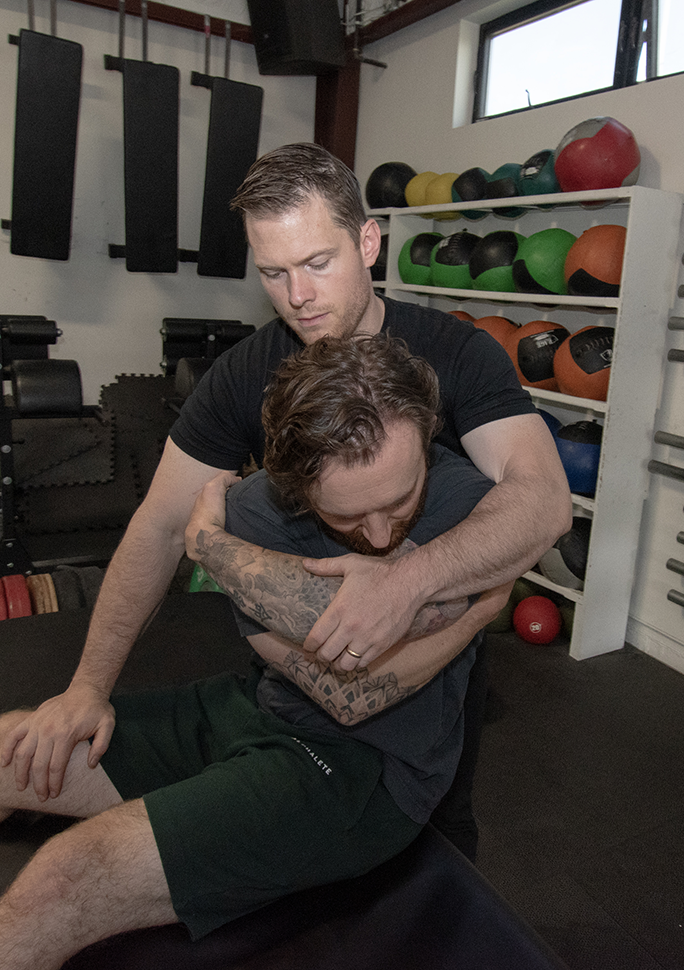
How Manual Therapy Fits Into A Performance Shoulder Plan
Hands on work by itself is like loosening a rusty bike chain and then never riding the bike. You feel better for a short time, but nothing really changes in your performance or durability.
In a performance setting, manual therapy sits inside a bigger structure that supports your shoulder over time.
- Structure: free up stiff joints and tight tissues so your shoulder has room to move
- Mindset: help you understand that your shoulder is adaptable and not fragile
- Movement: reinforce new motion with precise, well coached patterns
- Capacity: build strength, power, and endurance that match your goals
A typical session might look like a short but focused series of steps.
- Quick re check of how your shoulder moves in the lifts or positions that bother you
- Focused manual therapy to create a short term change in pain or range
- Immediate follow up with activation work for your rotator cuff and shoulder blade
- Progression into loaded patterns such as rows, presses, carries, or overhead work, adjusted to your current level
You leave feeling like you completed real training, not just a spa visit.
That combination of hands on work and smart loading is what leads to better performance, not just temporary relief.
Keeping You Training While Your Shoulder Recovers
For most Denver athletes, stopping all training is not an option.
You have races, ski season, pickup games, or simply your sanity on the line.
Thoughtful manual therapy for shoulder pain helps widen the range of motions and loads you can handle, which lets you modify instead of quit.
For example, different sports have different smart adjustments.
- Lifters: swap barbell overhead press for landmine press or half kneeling single arm dumbbell work, and keep squatting and hinging while adjusting bar position to protect the shoulder
- Runners and hikers: maintain mileage with small tweaks to arm swing and pack fit, and lean on strength sessions that focus on legs and core while the shoulder builds back up
- Court sport athletes: reduce overhead serves while you build strength into those patterns, and focus on footwork, lateral speed, and conditioning so your engine stays sharp
Manual therapy creates room for these modifications to feel good instead of risky. This approach lets you maintain fitness, rhythm, and confidence while your shoulder adapts and grows stronger.
A nagging shoulder can steal a lot of mental space, especially when you care about your training. A few focused sessions that blend manual therapy, strength, and clear guidance can shift your trajectory and give you back a sense of control.
If your shoulder has bothered you for more than a couple of weeks, or you keep modifying the same workouts without real progress, this is a good time to have a skilled set of eyes on it.
You can call TruStrength Performance and Rehab at (720) 983 3665 to schedule a visit or claim one of the offers above, and take the next step toward a shoulder that lets you lift, run, and play with confidence.
When Manual Therapy Makes Sense And When It Is Not Enough
Manual therapy is a powerful tool, but it is not magic.
It works best when your shoulder responds to movement and when you can still do most daily tasks but feel limited in sport.
Good signs it may help you include several common patterns.
- Your shoulder eases up when you warm up or move around
- You notice specific angles or loads that cause a pinch, but others feel fine
- You feel tight, heavy, or guarded more than truly weak
On the other hand, you need more than just hands on work if certain warning signs show up.
- The same area flares up every time you return to particular lifts or serves
- You notice clear loss of strength, endurance, or speed on that side
- Pain wakes you regularly at night or stops you from basic daily tasks
In those cases, manual therapy can still play a role, but it needs to live inside a clear, progressive plan that addresses strength, control, and the specific demands of your sport.

From Table To Training: Turning Relief Into Real Shoulder Strength
The real payoff comes when you use manual therapy as the starting point, not the finish line.
Once your shoulder feels a bit looser and less reactive, it becomes easier to teach it how to handle real life again.
You can think about progress in three simple stages that build on each other.
- Calm and control: isometrics, light band work, and simple patterns that feel safe and stable
- Strength and range: pressing, rowing, and reaching in more challenging positions with thoughtful load
- Power and sport: dynamic work that looks like your actual sport, such as push presses, serves, or overhead swings
Each time you have hands on work, you have a short window where your body feels more willing to move. The athletes who progress fastest are the ones who use that window to train smart, even if the weights or ranges look different from their normal peak.
Common Mistakes Active Adults Make With Shoulder Pain
If your shoulder has bugged you for months, you have probably tried a lot of things already.
Some of the most common habits in active adults actually slow progress, even when they come from good intentions.
Watch out for these patterns that often show up.
- Only stretching the front of your shoulder and chest without building strength in the back
- Doing endless light band external rotations that never progress in load or complexity
- Relying only on massage, foam rolling, or self mobilization with no strength work to follow
- Avoiding all overhead work for months, which can make you more sensitive when you finally try again
- Skipping warm up and activation on busy days, then jumping into heavy or high speed work without preparation
Manual therapy works best when it breaks these cycles and gives you a clearer path forward.
It is the combination of hands on care with smarter training choices that actually changes your shoulder story and your long term performance.

Practical Self Care That Pairs Well With Manual Therapy
You do not need to live in a clinic to make real progress.
Small, consistent habits support what happens during your sessions and help your shoulder feel ready when you walk into the gym or onto the court.
Useful options include simple strategies that fit into your day.
- Daily mobility snacks instead of long, random stretching sessions, such as a few arm circles, wall slides, and gentle thoracic rotations between meetings
- Short bouts of isometric strength when things feel stirred up, such as pressing into a wall or holding a light weight at a safe angle for twenty to thirty seconds
- Regular scapular and upper back work, including rows, face pulls, farmer carries, and light prone exercises to keep your base strong
If you live or train around North Denver, Centennial, Ruby Hill, Hampden, or Whittier, you can easily fit these into your routine. You might do a quick warm up before a Cherry Creek run, a short shoulder circuit before a Station 26 meetup, or a few activation drills before an evening high intensity class.
The goal is not perfection. The goal is to stack enough smart reps, supported by targeted manual therapy for shoulder pain, so your shoulder feels like an asset again instead of a constant question mark.
From Short Term Relief To Long Term Shoulder Resilience
How We Support Active Shoulders, Not Just Sore Ones
You are not trying to protect a fragile shoulder; you want to build a stronger, more durable one that can handle your sport.
At TruStrength Performance and Rehab, we focus on manual therapy paired with smart strength and movement progressions so your shoulder supports your life in the gym, on the trail, and on the court.
When we work with you, we look at your whole system, not just one joint.
We consider your lifts, your weekly mileage, your court time, your desk setup, and your recovery, then build a plan that keeps you as active as possible while your shoulder improves.
Why A Performance Focused Approach Matters For Active Adults
As an active adult, you do not just need less pain; you need capacity. You want to press overhead, carry kids or skis, and still feel ready for a 14er or a long ride.
A performance lens means we use several pillars to guide your plan.
- Use manual therapy to open up motion and dial down irritation
- Layer in strength and control that match your real sport demands
- Adjust your training instead of stopping it so your identity as an athlete stays intact
- Track progress with clear, objective markers that make sense to you
This keeps your plan grounded in what matters most, which is how your shoulder performs when it counts.
Support That Fits Real Denver Schedules And Training
You juggle work, family, and training, so your care has to respect that.
We design time efficient sessions that combine assessment, hands on work, and targeted strength so you accomplish more in each visit.
With locations in North Denver, Ruby Hill, Hampden, Whittier, and Centennial, you can fit support around morning classes, evening runs on Cherry Creek Trail, or weekend mountain days.
You do not have to choose between staying active and taking care of your shoulder.
Ready To Move Past Shoulder Pain And Back Into Your Sport
A nagging shoulder can steal a lot of mental space, especially when you care about your training. A few focused sessions that blend manual therapy, strength, and clear guidance can shift your trajectory and give you back a sense of control.
If your shoulder has bothered you for more than a couple of weeks, or you keep modifying the same workouts without real progress, this is a good time to have a skilled set of eyes on it.
You can call TruStrength Performance and Rehab at (720) 983 3665 to schedule a visit or claim one of the offers above, and take the next step toward a shoulder that lets you lift, run, and play with confidence.